
Understanding your child's educational rights shouldn't require a degree in special education. Here's what Pennsylvania parents need to know about IEPs, 504 plans, school evaluations, and getting the right support.
If you've ever sat in a school meeting and heard terms like IEP, 504 plan, evaluation report, accommodations, or specially designed instruction, you know how quickly the process can become overwhelming.
Maybe your child is struggling to keep up with assignments, having difficulty staying focused, experiencing anxiety at school, or falling behind despite putting in their best effort.
You want to help, but knowing where to start isn't always easy.
Having worked as a school counselor, I've seen how confusing the process of obtaining academic support can feel for families. Parents often have important questions but aren't always sure whom to ask, what their child qualifies for, or what happens after they request help.
The good news is that Pennsylvania has established procedures to help students with disabilities access appropriate educational support.
Whether you're just beginning to explore accommodations or preparing for your next school meeting, understanding the differences between an Individualized Education Program (IEP) and a Section 504 plan can help you feel more prepared to advocate for your child.
What Is the Difference Between an IEP and a 504 Plan?
Both IEPs and 504 plans are designed to support students with disabilities, but they serve different purposes.
An Individualized Education Program (IEP) is developed under the Individuals with Disabilities Education Act (IDEA). It is intended for students who meet specific disability eligibility requirements and need specially designed instruction.
A Section 504 plan is generally used to provide accommodations, services, or other supports that allow a student with a disability to access school programs and activities.
Here's a simple way to think about the difference:
An IEP addresses a student's need for individualized special education instruction. A 504 plan addresses disability-related barriers to accessing education, which may be addressed through accommodations and services.
Importantly, neither plan is automatically better than the other. What matters is identifying what your child needs to participate and make progress in school.
IEP vs. 504 Plan: A Quick Comparison
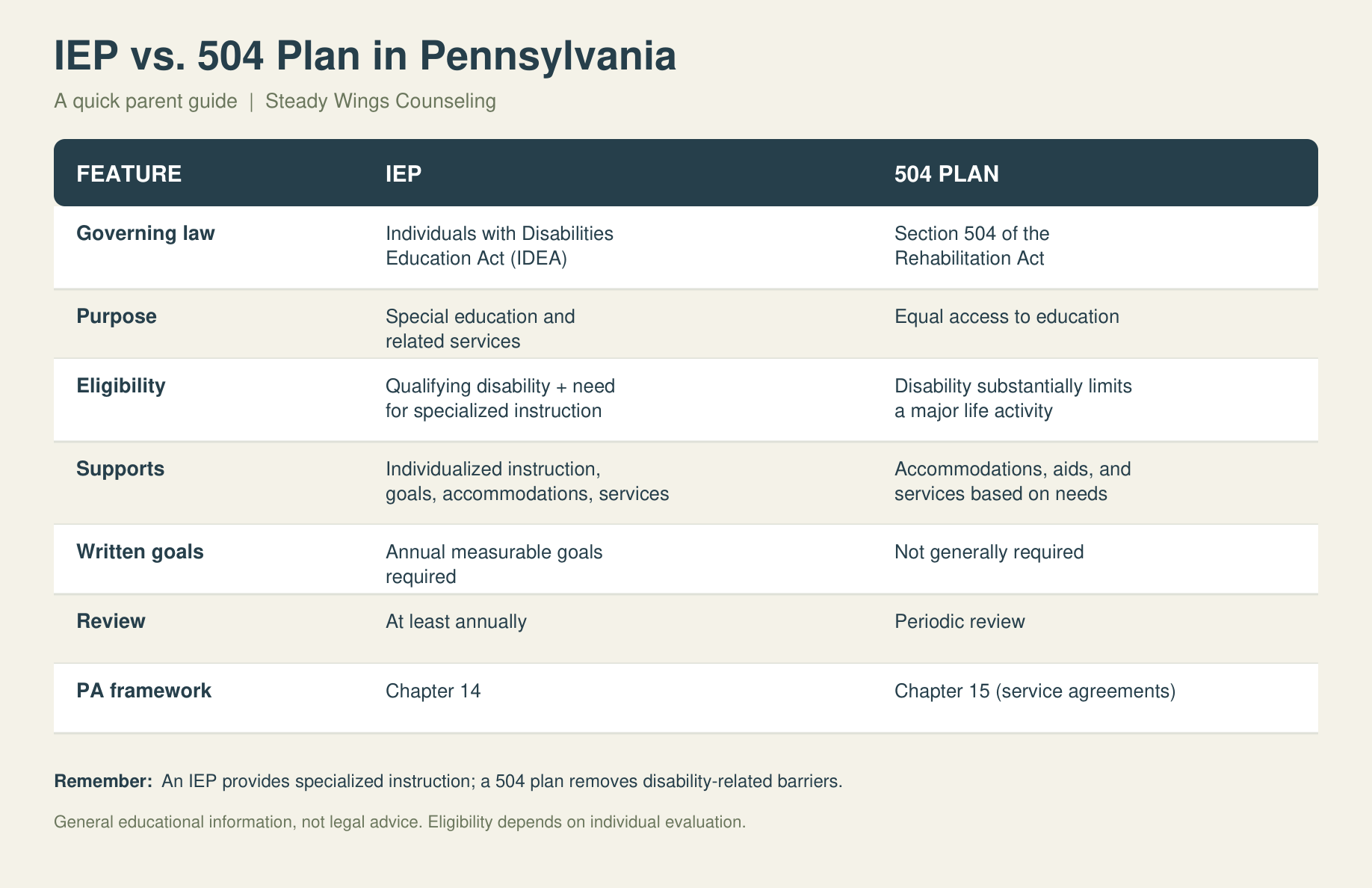
A student receiving an IEP is also protected by Section 504. However, a student can qualify for a 504 plan without qualifying for an IEP.
What Is an IEP in Pennsylvania?
An Individualized Education Program is a written educational plan developed by a team that includes parents, educators, and other appropriate school professionals.
An IEP outlines how a student's disability affects their education and identifies the instruction, services, accommodations, and measurable goals needed to support their progress.
For example, a student with ADHD might need more than additional time on tests. They may require individualized instruction targeting organization, task completion, or other disability-related learning needs.
Another student with a specific learning disability might benefit from specialized reading instruction, academic goals, and progress monitoring.
Depending on eligibility and individual needs, an IEP may include:
Specially designed instruction
Academic or behavioral goals
Speech, occupational therapy, or other related services when appropriate
Testing and classroom accommodations
Behavioral supports
Progress monitoring and regular reports to parents
Transition planning for life after high school
Not every student with ADHD, anxiety, autism, or a learning disability automatically qualifies for an IEP. Eligibility depends on the evaluation findings and whether the student needs specially designed instruction.
What Is a 504 Plan in Pennsylvania?
A 504 plan can help students whose disabilities interfere with their ability to access school, even when they don't require special education instruction.
For example, a student with ADHD may understand the classroom material but struggle with sustained attention, organization, or completing tests within the allotted time.
A student experiencing significant anxiety may need accommodations that help them participate in school activities or manage disability-related barriers.
Depending on the student's individual needs, accommodations might include:
Extended time on tests or assignments
Preferential seating
Breaks during lengthy tasks
Access to a quieter testing environment
Organizational check-ins
Adjustments to classroom procedures
Supports related to a medical or mental health condition
These are examples, not automatic entitlements. Schools must determine which accommodations and services are appropriate based on the student's needs.
In Pennsylvania, Section 504 supports in public school districts are generally addressed through Chapter 15, which refers to written plans as service agreements.
Can My Child Get an IEP or 504 Plan for ADHD or Anxiety?
This is one of the most common questions families have.
The answer is yes, potentially. However, having a diagnosis does not automatically guarantee eligibility for either plan.
For an IEP, the evaluation must establish that the student meets IDEA eligibility criteria and needs specially designed instruction.
For Section 504, the school considers whether the student has a disability that substantially limits one or more major life activities, such as learning, concentrating, thinking, or other covered activities.
A student doesn't necessarily need failing grades to qualify for support.
For example, a student may earn good grades while experiencing substantial difficulty concentrating, managing anxiety, or completing everyday academic responsibilities.
The important question is how the disability affects the student and what support is necessary.
How Do I Request an IEP or 504 Evaluation in Pennsylvania?
If you're concerned about your child's academic, emotional, or behavioral functioning, you can begin by contacting the school.
I generally encourage parents to put their concerns in writing rather than relying only on a conversation.
For an IDEA special education evaluation, Pennsylvania parents can submit a written request to the school. The school must follow the applicable procedures for responding and seeking consent.
For a Section 504 evaluation or Chapter 15 services, parents can also submit a written request describing their concerns and the support they believe their child needs.
A request might look something like this:
"Hello, I'm writing to request an evaluation to determine whether my child may qualify for an IEP or Section 504 accommodations. I've noticed ongoing difficulties with attention, organization, and completing school assignments, and I'm concerned these challenges may be affecting their educational experience. Please let me know the next steps and any paperwork needed to begin the evaluation process. Thank you for your help."
Keep a copy of the request and any responses.
One important distinction: for an IDEA evaluation, the 60-calendar-day evaluation period generally begins when the school receives your signed written consent—not simply when you send the first email asking about an evaluation.
Important IEP and 504 Deadlines Pennsylvania Parents Should Know
One of the most helpful things parents can do is understand which timelines apply to their child's evaluation and educational plan.
Unlike college application deadlines, IEP and 504 deadlines are usually calculated from specific events, such as the date a school receives parental consent or the date an evaluation report is issued.
That means there isn't one universal IEP application deadline each school year.
The following timelines are especially important for families in Pennsylvania.
1. Special Education Evaluation: 60 Calendar Days
In Pennsylvania, an initial special education evaluation generally must be completed within 60 calendar days after the school receives written parental consent.
However, Pennsylvania excludes the period between the end of the spring school term and the beginning of the fall school term from this calculation.
This means an evaluation started near the end of the school year may take longer in actual elapsed time.
2. Evaluation Report Before the IEP Meeting: 10 School Days
Parents must generally receive the evaluation report at least 10 school days before the IEP meeting.
This gives families an opportunity to review the findings, prepare questions, and understand the school's recommendations.
Parents may waive this advance-review period in writing, but they shouldn't feel pressured to do so.
3. Initial IEP Development: 30 Calendar Days
When a student is found eligible for special education, the IEP must generally be completed within 30 calendar days after the evaluation report is issued.
The IEP team works together to establish the student's educational goals, accommodations, services, and individualized supports.
4. IEP Implementation: No Later Than 10 School Days
Once the IEP is completed, it must be implemented as soon as possible and generally no later than 10 school days afterward.
Parents should understand when services will begin and whom to contact if the agreed-upon supports aren't being provided.
5. Annual IEP Review: At Least Once Every 12 Months
An IEP must be reviewed at least annually.
During this meeting, the team examines the student's progress, discusses ongoing concerns, and determines whether changes are needed.
Parents don't have to wait for the annual review to raise concerns or request a meeting.
6. Special Education Reevaluation: Generally Every Three Years
Students receiving special education must generally be reevaluated at least once every three years, unless the parent and school agree that a reevaluation is unnecessary.
In Pennsylvania, students identified as having an intellectual disability must be reevaluated at least once every two years.
A reevaluation may also be requested sooner when a student's needs have changed, subject to applicable rules about frequency.
7. Pennsylvania Chapter 15 Request: 25 School Days
Pennsylvania's Chapter 15 rules establish an important deadline for parent-initiated requests for services.
When a parent submits a written request for the provision of services, the school district generally must evaluate the information submitted and provide a written response within 25 school days.
This is different from the IDEA's 60-calendar-day evaluation requirement.
Section 504 also requires appropriate evaluations and periodic reevaluations, but it does not establish the same nationwide 60-day timeline used for Pennsylvania IDEA evaluations.
A Quick Deadline Reference for Parents
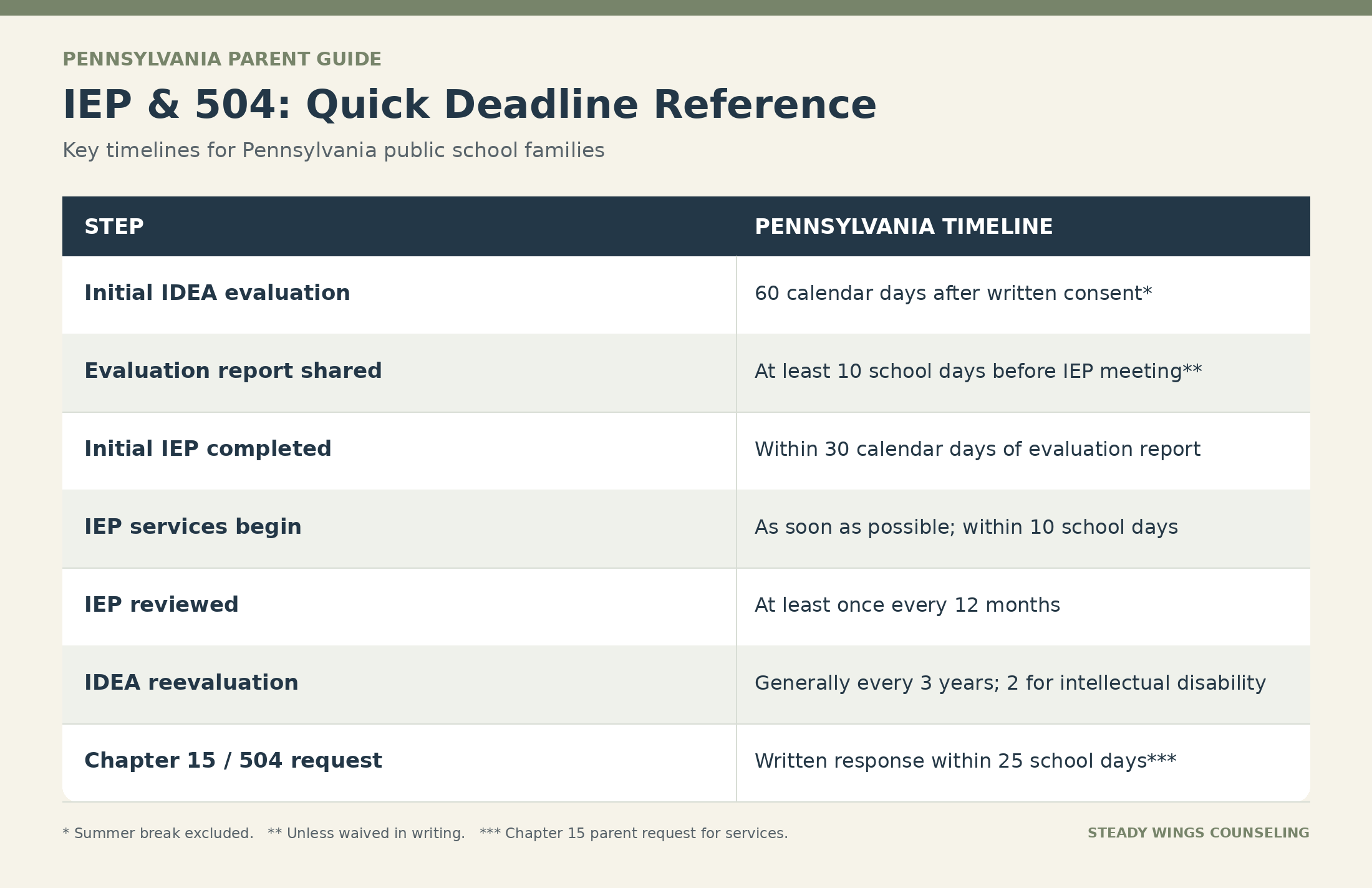
Parent tip: Calendar days and school days are not interchangeable. When you receive paperwork, record the date the school received it and ask the school to confirm the applicable deadline in writing.
Looking for Support With School Stress, ADHD, or Academic Challenges?
At Steady Wings Counseling, I draw on my experience as a school counselor, child and family therapist, and Licensed Professional Counselor to help students and families navigate the emotional and academic challenges that can make school feel overwhelming.
Whether your child is struggling with ADHD, anxiety, organization, academic motivation, or the transition to a new school, I'm here to help you better understand what they're experiencing and find a way forward.
While therapy is not a substitute for formal special education advocacy or legal representation, my school counseling background allows me to appreciate how educational supports and mental health care can work alongside one another.
If you're concerned about your child's experience at school, reach out for a free 15-minute consultation. I'd be happy to hear what's been happening and talk about how counseling may be able to help.